Wednesday, August 6, 2008

Capetown - 5/21

May 21st

My boss noticed that I was not looking so good. I was strongly urged to take my first Rest and Relaxation vacation. Now I see why these trips are necessary. I decided to visit South Africa (SA). I have an old friend Capetown. I stayed with her family which included a young boy of 3 called Boyou. SA was quite cold; it was the middle of winter. Capetown is glorious. And Boyou was such a joy. It is sooo much energy to take care of a child, but at the end of the day I had good energy. I have to say that the my friends helped me have a great time.. by letting me not plan a thing. And Boyou was the best part of it.

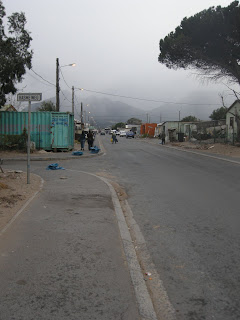
I also went to visit the Townships; area where black people live. I went to Mazapulele Township, right next door. The xenophobic attacks also occurred in Capte town, however I heard that the Mazapulele township elders really organized the community. They were able to convince the people who looted the foreigner’s homes to return their property. And they also got the community to really reconsider their position of violence. It was quite a exciting to hear. A people who have experience so much violence, yet choosing a different action. The situation in the townships is not always so pretty due to the poverty of blacks in general. One good thing though, is that these homes have running water and electricity. However the townships are not large enough and there are many slums. I saw acres and acres of slums on the way to the capetown airport. Quite disheartening. I hope that SA can really begin to bridge the gap for poor SA's.

A few scenes of my time in capetown. If you have a chance, I think it is a beautiful place to visit.

Muzaphalele township

Muzaphalele township (above)


JOHANESSBURG
I also got to visit my friend in Johannesburg. Quite a city. The walls protecting the homes are so high, with electric wires on top. There is a lot of crime in the city, most probably due to the huge disparity between the rich and poor. The city felt very unfriendly. I think it takes a while to feel comfortable here. I got to see the famous SOWETO and Mandela's home from his childhood.


Now back to my live in Juba.

Triste - 5/19

May 19th
It’s now raining season which is nice. I’ve been here for 3 months now. We arrived in February which is considered the hottest time of the year. So we are happy for the rain.

And I just had my first big frustration period. So this is my ranting outlet.

Doing things here is quite a task. Just a simple task of going to work in the morning, can take a 20-30 mins in planning. Who is going where, is everyone ready, why are we waiting for one person to finish combing their hair. So many things break down in mid stream without a process of how to fix it. For example, a simple task of printing can become a 2 hour affair when the printer is not properly aligned. Where is the technician!!!!

I also live with other people, sometimes only 3, and other times 6 at a time. The constant flux of people coming in and out of the guest house is straining. I have no anger towards the visitors, more so the flux. It's hard to have a visitor every week.

I’m trying to see the good side about this. This could be an opportunity for me to see how I deal with these situations. Where can I have such an experience? Really no-where and some may say, why do u really want it. But somewhere in there, I think there is a learning opportunity. Haven't found it yet!

But a week after I got so frustrated, I learnt something about myself. As an independent woman in her "late twenties", don't laugh... I have been doing so many things by myself and depending on me most of the time. Since we live in a group, there are some things that I am powerless over; what food we eat, whether I can get go out some evenings, the level of security we have in the house etc etc. Most evenings, we didn't have access to transportation, and it's not safe to go out by oneself. So we'd stay home with the collegues that we just worked with for 8-10 hours. Nothing against them, but it's like having turkey sandwich every night of the week. And I had this growing frustration that surprised me. I really found it difficult to trust other people to decide things for the house (including me in the picture). So that was very interesting for me to watch.

This situation continued, like a drip that digs a deeper hole every day. And I waged wars sometimes to change one thing or the other. But after a while, I kinda gave up. And I think that was actually a good process. Learning to just trust the process and trust in something bigger than oneself.

When I sit back and look at how upset I got sometimes, I just laugh. It is really funny sometimes. So as a pat on the back, I'd like to give myself a break!

Rumbek Travels - 5/12

May 12th
(More about my Rumbek trip – sorry I know I’m repeating, but there are more pictures) So this is one of my first trips out of Juba. I was asked to participate in an assessment study of groundnut production. We flew to a town call Rumbek, which has a lot historical meaning in Sudan (as i mentioned last time). Hometown of John Garang. It was an unlikely capital because it had no paved roads and only had a population of 100k. But once Garang died, the capital was moved to Juba, which is larger and has some infrastructure, very little, but more than Rumbek.

In this trip I got the change to experience a landing on a dirt runway. I was truly scared, but I felt stronger after that experience. laugh!

We are constantly confronted with the remnants of the war. We had two members on the team who were formerly in the army (one of whom was only 14 when he was drafted). We approached this a town where there were holes dug out all along the ground. One of the former vets in the team told us about the fight that happened just 4 years ago in this very spot, and how he was part of the fighting that won the city back to the South. The dug out holes were used by the Northern army as a defense mechanism. This sent chills down my back. Everywhere we went there are left over shelled tankers, sometimes bombed helicopters, and old rusted bullets still lying randomly on the ground. And the demining team, who are constantly working on roads and farmland.


The cultures are so rich here. I didn’t want to stare, but the facial markings were so different for me. I don’t know if this is true, but I was told the culture of markings came from the missionaries/colonials who needed a way to identify one tribe from the other. Some other tribes remove the front 6 lower teeth. Yes ouch! And I couldn’t help noticing all the cows, everyone we went there were herds of them. Cows are considered a sign of wealth, so no-one is willing to sell their cows. Most of the beef eaten in southern sudan is imported from Uganda and Kenya, yet if you fly over Southern Sudan, you’ll see acres and acres of grazing cows.


Well once we got to Rumbek, I had a chance to visit some smaller towns / villages. We went to visit farmers, some of whom are recent returnees from refugee camps and some of whom lived here through the war. I found the Dinka’s huts very interesting. The farmers lived in these interesting huts that were mounted on sticks; it was like a 2 story hut. The height was used to deter animals from getting to their grains. In terms of marriage, there are no limits to the number of wives you can have. We met a man who had 9 wives, I was aghast. But he had good harvests and felt he could afford it. I have heard of a big chief who had 50 wives. So this man with 9 wives and quite a number of children, had three huts in his compound; One for him, one for the goats and one hut (on sticks) for the grains. The wives and kids slept under the hut on sticks. This was a very strange concept for me, but it is very accepted. I guess the grain is more important!

As most people have cows, the cows need to be fed constantly. Out of necessity and a way to support each other, most area’s have this things called “cattle camp”. Essentially groups of people join their cows together and send representatives from their family to manage the herd. The cow herders travel together in one group, setting up temporary camp and then moving once the grass is all eaten by the cows. Cattle camps of for young people, women, older parents and can be really important growth period in young boy’s lives. There can be up to 100 people in a cattle camp. A lot of people actually enjoy the camp because it is like a big camp party. There are a lot of young men who earn their right of passage by going through cattle camp. So it seems to be quite a significant part of their life. The herders burn the cow dung and smear it on their bodies to keep away tse tse flies. The cow dung is white, so they look a bit like ghosts. It’s a mixture of this elaborate clothing, deep facial scars and white dust on their faces. I have a picture in one of my albums. I really like that picture.

I was quite shocked by the level of comfort with nudity, most people had. In very remote areas most kids under 10 are naked and sometimes parents were partially naked. The kids all seemed happy though. It’s nice to see the smiles, contrary to the starving image on the news. After a while, it felt quite normal and I stopped starring. I guess in some ways if you can do this, there is less shame about the body.


I couldn’t help thinking how it seems like the world had stopped in this place. Cultures have been insulated by the war. And the bare necessity of just living is so apparent here. In the car, you can stand on top and look as far as the eye can see. The landscape is absolutely breathe taking. Virgin land, untouched and still. Such a contrast, 20 years of war (some parts brutal) and this virgin unbroken landscape. Hard to capture on camera... but this is my attempt.


I really enjoyed my trip to Rumbek. It was hot, and cramped at times. I had to stay at a camp where the rooms had lizards and frogs as regular visitors. But it was so much fun. I guess for a week, everything is still exciting. The camp we stayed in was owned by a Norwegian organization that had been in Sudan for 20 years; this means they were there even through the brutal times of the war. But somehow the locals knew and trusted them. So when war broke out, they always warned them or tried to avoid their area. Very touching to learn about their history and how this relationship developed. So the Norwegians are loved in Sudan.


Well I hope you enjoyed this. A small sliver into life here.

Wednesday, June 18, 2008

First Blog - 3/15

March 15th

So it’s been 6 weeks since I landed in Juba, South Sudan. We landed at Juba airport, which is not much larger than the airport in a city like Burlington, New Hampshire; it’s very small. As we flew into the town, I saw the tops of huts lined in rows and a few scattered building in the town of Juba. I thought maybe these were the suburbs of Juba, but this is actually Juba town. About 80% live in mud huts. As we landed, I saw the UN helicopters that are usually used to transport tankers and large quantities of food and an old burnt out artillery fire arm. And the reality that this country has been in war for 20 years hit me. It was an emotional landing. I was so sad to see that so many people had suffered and were still suffering. But this may just be my western concept of suffering. Whatever the case, it is still a struggle for many southern Sudanese.

Customs was a quick process. Our bags came in through the side carrier on trucks which we had to pick up. Definition of carrier: a wooden half broken door with a concrete slab. Our entire luggages were visually examined and to my surprise, no bribe was asked for (bribes are a natural occurrence at the int’l airport in Nigeria). The first sight of juba is the red dry earth and the dust that is left behind the trucks that speed pass you. We had been prepared for the worst, so I didn’t expect to have many things. To my surprise, we were put in a guest house that was a concrete structure and there was running water, sometimes even hot water for a shower. The guest house is right next to the office, so there isn’t much separation between work and home. Space in Juba is very tight, so everyone is living over each other. Hotels that set up in Juba found that it wasn’t even necessary to spend money building structures; they could charge an arm and a leg for those large army tents. They just build an adjoining structure for the bathroom and added the tent next to it. The charge is only $200 per night. That’s supply and demand at its finest. So getting any type of solid structure is a step up, especially in 100 degree weather. We even had air conditioners in our rooms, which was even more of a surprise. As you can tell, I was prepared to rough it.

So we settled into our routine. There are four of us being sent to Southern Sudan for this round. Ryan; frat boy / entrepreneur from buffalo, Marty; former army interrogations specialist / HR guy (he is a bit strange at first, but actually he is the sweetest guy ever. Not sure how he got into the army), Michelle; VP from Goldman sacs (Korean American, 5ft small cute, but don’t’ get on her bad side type of girl) and yours truly. So we both hung around for 4 week in Juba with our one of the other MBA volunteers who has been in Southern Sudan (another town called Wau) for 6 months. He showed us the ropes and did a bit of the orientation. Khary is from little rock Arkansas and is the only brother (black westerner) for miles. So we have all lived in the guest house for that time. It felt a bit like the “MTV real world” for a bit. But we seemed to all get along really well. The 2 guys left to their posted cities of Yei, where they will be for the rest of the 14 months. And michelle and I, after 2 weeks of sleeping of the jet lag and a bad case of cough, finally started got into work.

We have a few small business clients assigned to us. We asses where the business is and where they need to go in order to make their business work. The businesses that come to us are usually very small businesses and sometimes we get medium sized ones. Because of the war, there are so many people who have lost their age old skills like welding, carpentry, businesses mindset in general. This cannot even be classified as an emerging market right now (pre pre emerging). Most of what we do is just help them understand the concept of marketing their business; most believe they build and customers will come, diversify products; so they are not dependent on the swings of just one product, and force (yes I said forcing cos they take this part kicking and screaming) them to think about whether they are profitable or not. For the latter, most people only think of gross revenue as their indicator for making money. They take money in and put it into the right pocket and when they pay, they pay from the left pocket. And I am really serious; this is how most people who do it. So just a glimpse of what we do here.

There are tons of expats in Southern sudan. Many many ngo’s and private enterprises also. We also have the de-miners (take out the mines) in south sudan. They have done quite a bit of work and all the major roads have been demined and major towns also. But they are the toughest looking people here. The UN has a mini town close to the airport. And we go there to run around the track. There are SUV trucks all over the place. As Juba has only one paved road, the need for trucks are paramount. I seem to go out more here in Juba than I do in DC, well some may argue with me, but there is more activity than I anticipated. Most people hang out at the hotel bars (remember most hotels don’t have tall structures), so they are actually nice to be in. There are quite a few hotels by the water front. It’s amazing because I was told that 3 years ago there were almost no expats in Juba. It’s almost like the gold rush here.

I am supposed to work in the ministry of agriculture, but that has not happened yet. I hear that working there is a riot. But that will be for another blog day. But as part of my involvement in agriculture, I was able to do some research on wood in southern sudan. Apparently Southen sudan has an abundance of Tick and Mahogney which is rare around the world. This has caused a huge commotion in the open market and everyone has eyes on these natural resources. Before the peace agreement, timber was smuggled out in truck loads. Some of the local villages used to burn tick as fire wood; if you know anything about tick, you know that is one of the most expensive pieces of wood in the world, so it’s like taking gold and using is as fire wood. Well they didn’t know. However there aren’t any substitutes nor do they have factories that can make different grades of wood. So all the furniture is made of “pure solid mahogany” . So you know that if you every bought a piece of solid wood, talk less of mahogany, you’d pay and arm and a leg. Here they make beds and sell them at $100 - $300 a piece. And because they don’t have the good craftsmanship, they quality is so bad. It is so sad to see. But I do have hope that they will harness their resource of mahogany very soon. There are many consultants working with the govt. on this.

So I got assigned to work on a value chain study for a particular crop here in Sudan. This actually has been one of the most interesting things that I’ve done. We travelled to a city called Rumbeck and spoke with farmers, local govt officials etc. Most of the pictures below are from this trip. We had two people who had fought in the war, they would tell us all sorts of stories of ambushes and actual warfare that they participated in, in that town. It’s amazing that is was so close. We stayed at an NGO camp that has been around for 20 years in southern sudan; even through the war. So they know all the stories. This was real field work. My room had a few lizards that scurried out as I went in. And the pit toilets were even more fun!

We got to talk to farmers, one of whom had 9 wives. I couldn’t believe it. Every house had about 5-15 people; wives and children. However there was only one tent where the man slept. It is interested that they don’t build huts for the wives or kids. They all sleep under the storage unit. Well that is dinka culture. And the Dinka value cows more than anything. This is almost like money to them. They trade many things in cows, dowrey, crimes etc. if you kill a man, you have to pay 31 cows to the family. A bride downrey can be anything from 50-200 cows; cows cost about $200 a piece. No dinka ever wants to sell his cows. Many western thought that the cow herding was prime for a meat industry here, but culture dictated otherwise. They wouldn’t even use the ox to plow the land, because it was against their culture. But some have soon abandoned that when they saw how much extra money they could make with the oxplow. Anyway, if you hit a cow, be prepared for a war here.

PS dinka tribe is the largest in southern sudan and they are the most fierce; they are the ones that started the fight against the north and the whole liberation movement (Sudan People’s Liberation Movement SPLM) and the main leader was John Garang.

PPS I actually met john garang (for a brief second) when I worked at USAID one summer. He came to have some negotiations with USAID about working in Southern Sudan. A pity that he died just months after the peace agreement was signed (he lead the movement for 20 years).

Well I think this is it for now. Till next time.

Cheerio